Category: Uncategorized (Page 1 of 2)

Peer Review

Getting feedback from peers has really helped improve my essay drafts. In high school, peer reviews mostly focused on fixing grammar and sentence issues. But in college, peer review goes deeper—it looks at the big picture, like how the essay is organized, how paragraphs flow, and how strong the arguments are. It’s more about the smaller details, like making sentences clearer and having more powerful overall writing. By using tools like global revision, which is big picture stuff such as formatting structure, arguments, and evidence, and also using local revision, which is the way you manage your sentences or just clarity, which is more of the smaller tasks, it helps me cover all aspects from big to little. 

This semester, when I worked with classmates, through peer review, we would give and get feedback through rough drafts, and that would give me the opportunity to see other points of view, not only through a different set of eyes, but also through a different writing style. Everyone had been taught a different way in high school, and when we swapped writing, it would show. I got positive feedback, like ways to make my argument stronger, like adding clearer examples, fixing up grammar, or explaining my thoughts better. Reading their essays was just as helpful because I could learn from their style and ideas, then adapt those techniques to my own writing. Below you’ll find comments I’ve received, while also getting comments I have shared with my classmates, and you can see how two students might look at the same text and see two different things.

Peer review has also really pushed me to slow down and think carefully about why I make certain choices in my writing. It helped me see my work through the eyes of a reader, which made my revisions more focused on meaning instead of just fixing errors. Overall, it’s a key part of how I improve both my writing skills and my thinking about writing. 
Reading Response & Annotations

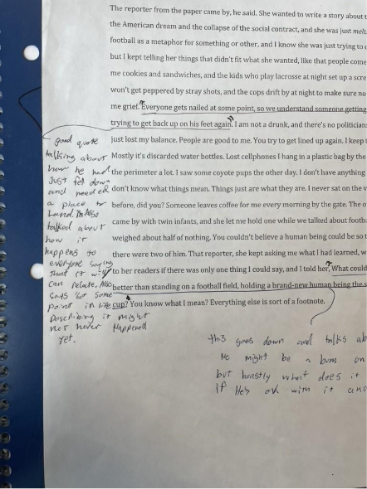
Looking back to the very first reading response of “The Hawk,” I realized how short and confusing they were. It matters little sense through my paragraph, and you can tell me the size of the response and the choice of words that I wrote in one go and never looked back or re-read it. As you can see in the example below of my response to Q4 for The Hawk: 

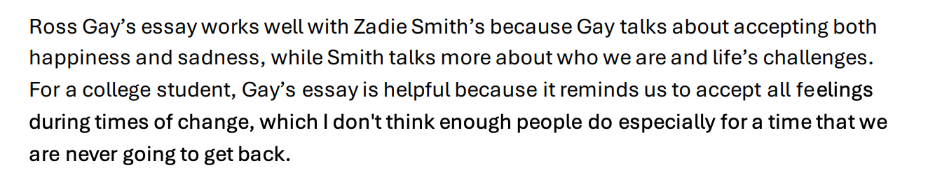
In a recent response where I was responding to “Ross Gay, “The First Incitement” Reading Response,” I generated this response below, and it’s around the same size as my first response, but you can tell the quality is way better. I give the first sentence sharing my main ideas, and then the rest of the response responds to the question asked.  

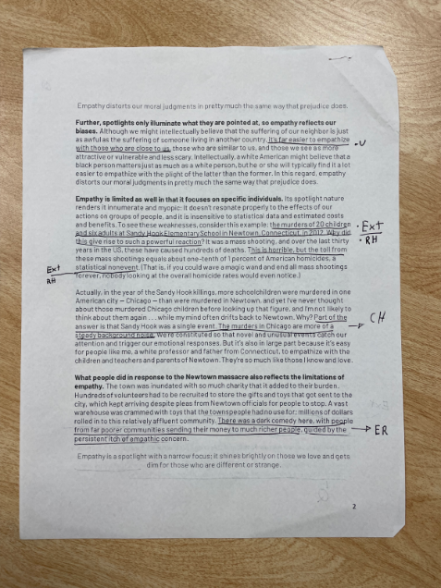
Over the first few weeks, my approach to annotation has changed a lot. Initially, notes were unorganized and confusing, making it hard to use them later in my writing. For example, when annotating “The Hawk,” I would underline large sections and write quick, scattered notes in the margins. This method became frustrating because when I went back to rereading, I couldn’t easily understand what I had meant, and it slowed down my process of finding strong evidence or meaningful quotes. Now, my annotation system is much cleaner and more organized. This change has also influenced how I preview texts. Instead of diving straight into reading, I skim for main themes or arguments first. This helps me frame my reading better and connect my notes to bigger conversations in my writing, rather than just summarizing the content.  

Overall, I can already see improvement in my annotation and previewing skills. With more practice and feedback, I’m confident I’ll continue to get better, which will help make my reading responses and essays stronger, clearer, and more connected to the larger ideas we discuss. Embracing this journey of refining my approach is helping me unlock my potential as a reader and writer.  

Integrating Sources

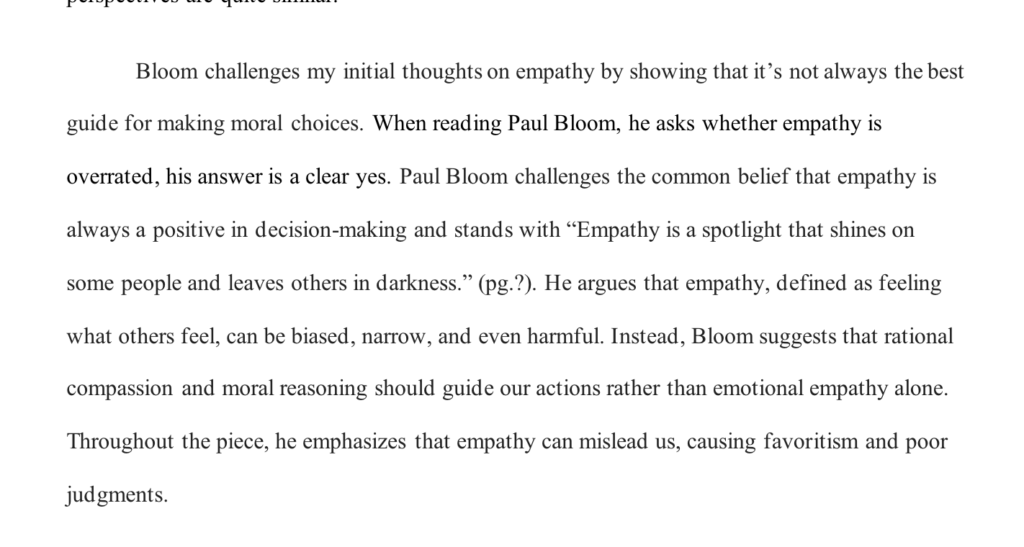
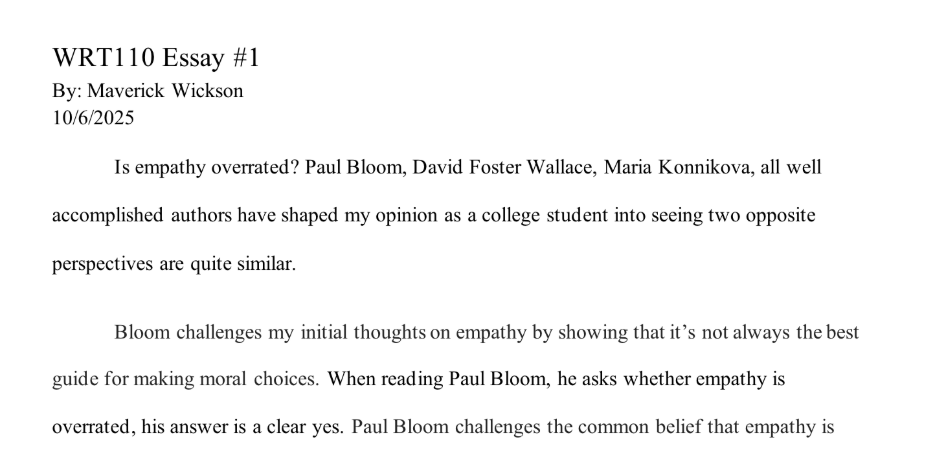
Throughout this semester, I’ve grown more skilled at getting stronger outside sources and incorporating them into my own voice in my essays. I’ve practiced using the Barclay paragraph structure, which helps connect to my sources before I start adding my own personal thoughts or point of few. Below is an example from my empathy essay’s rough draft. 

 I did a poor job introducing the authors and truly lost the correct format I was supposed to use. The writing before and after my sources is also weak, giving it a poor setup, and it isn’t helping the quote give more importance and a more overall impression.

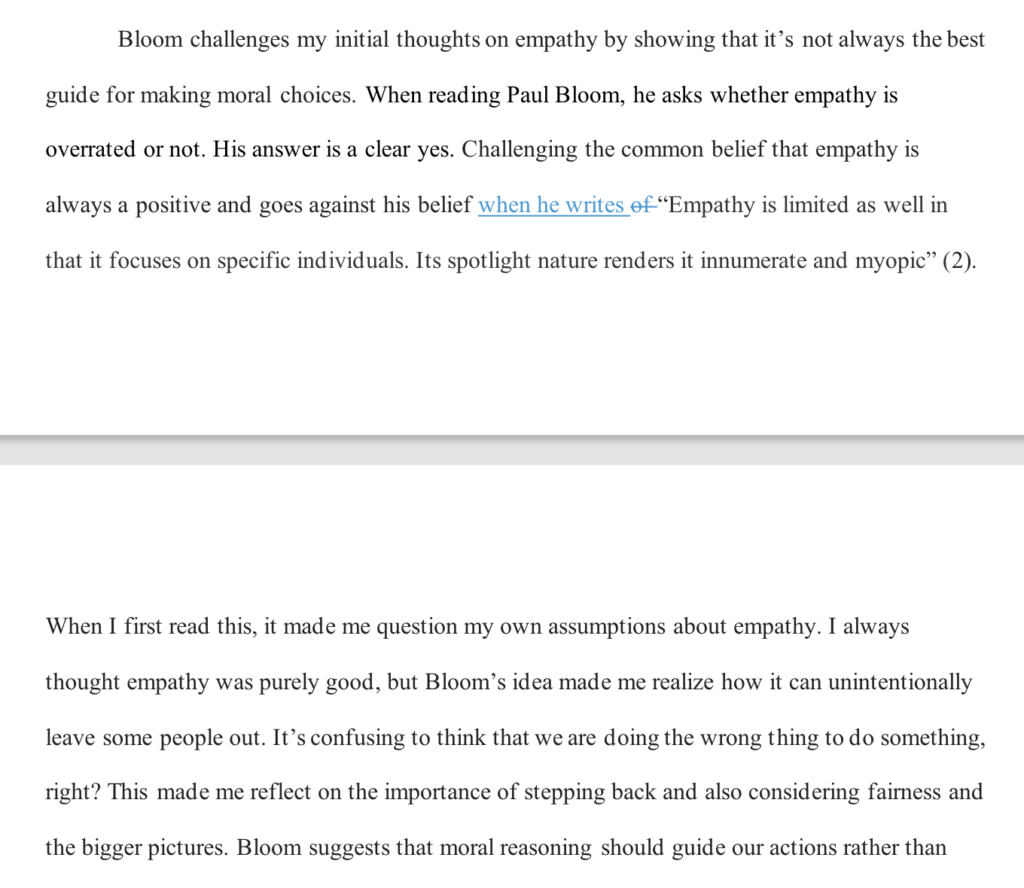
In my final draft, you can see the similarities, but there is a clear difference with more context around the quotes, making it clearer and better overall. The surrounding sentences connect to it, rather than just jumping straight into the quote as my first draft does. The final paragraph does a better job of clearly explaining Paul Bloom’s main argument and how it challenges my initial thoughts. It effectively uses a direct quote to support the point about empathy limitations, which strengthens the explanation. Overall, it’s clearer, more thoughtful, and connects well to the larger discussion about empathy that is missing in my rough draft. 

Over the semester, I have improved my ability to effectively introduce a source, quote it, and then explain its purpose through implementing Barclay paragraphs. This wasn’t all new information, but I hadn’t been able to get this much of an understanding of writing in high school classrooms. 

Revision

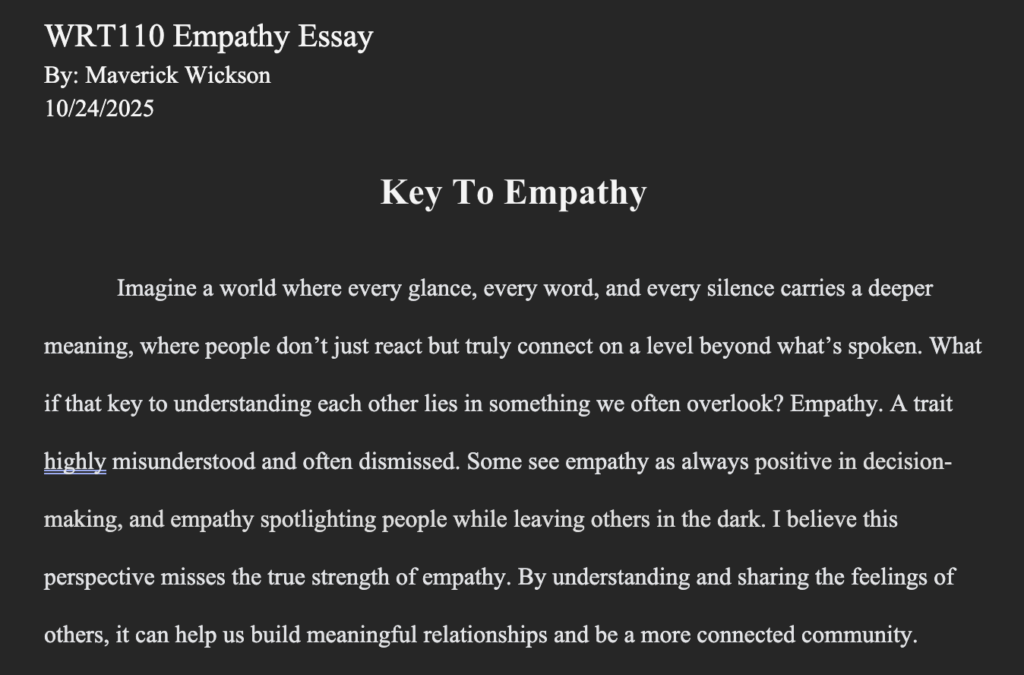
Back when I was in my high school writing class, revision wasn’t what we would mostly just focused on. We spent the majority of our time on paragraph structure or just working on getting the format down. Digging things like paragraph format, evidence, or even blending sources smoothly was just out of the picture, or something a step-up student would have to figure out. I didn’t enjoy revising—it felt as if I was wasting my time and skimming over it while thinking about other things. All I would focus on is catching spelling issues or paragraph formatting, but this semester has changed my view completely. I’ve realized revision goes way deeper than I assumed. Throughout this year’s semester, we worked on several essays and short responses that required me to revise my work. The most recent essay I wrote was about Empathy, and it is where I really applied what I learned about revision. This is my original introduction/hook 

My hook is weak, plain, and overall unattractive, but after feedback from my peer/professor, I was able to revise it and change it into a more grabbing and exciting intro to my writing:

My new revised introduction has the importance of empathy as a deeper way, and shows that  

– Empathy is often misunderstood or undervalued (main point) 

 – The common belief of empathy is commonly misunderstood. 

 – Empathy, by allowing us to understand and share others’ feelings, can help build stronger relationships and foster a more connected community.  
 

TRIAC-Home work

  1. Take a paragraph from your essay draft and paste into Brightspace. Using the TRIAC paragraph handout, revise the paragraph so it meets the requirements of the TRIAC structure. 

Pre-TRIAC: 

Bloom challenges my initial thoughts on empathy by showing that it’s not always the best guide for making moral choices. When reading Paul Bloom, he asks whether empathy is overrated, his answer is a clear yes. Paul Bloom challenges the common belief that empathy is always a positive in decision-making and stands with “Empathy is a spotlight that shines on some people and leaves others in darkness.” (pg.?). He argues that empathy, defined as feeling what others feel, can be biased, narrow, and even harmful. Instead, Bloom suggests that rational compassion and moral reasoning should guide our actions rather than emotional empathy alone. Throughout the piece, he emphasizes that empathy can mislead us, causing favoritism and poor judgments. 

Post-TRIAC: 

Paul Bloom challenges the common belief that empathy is always a positive force in moral decision-making. He argues that empathy, which means feeling what others feel, can actually be biased, narrow, and harmful. Bloom states, “Empathy is a spotlight that shines on some people and leaves others in darkness,” showing how empathy can favor some individuals unfairly. This means that relying solely on empathy can lead to poor judgments and favoritism because it doesn’t treat everyone equally. Therefore, Bloom suggests that instead of emotional empathy alone, we should use rational compassion and moral reasoning to guide our actions. 

DFW Reading Response

In his speech, DFW explores the idea that true freedom comes from how we choose to pay attention and what we decide to focus on in our daily lives. He argues that most people live on “automatic pilot,” caught up in their own frustrations and ego-driven narratives, which limit their ability to see the world and others clearly. DFW emphasizes that by shifting our attention and being aware of the present moment, we can break free from this and live more meaningful, compassionate lives. 

The author’s three main points are clear, and he stresses that “the really important kind of freedom involves attention, awareness, and discipline.” Highlighting that freedom is an active practice. Second, he points out that true empathy requires us to “care about other people and to sacrifice for them, over and over, in myriad petty little unsexy ways every day,” showing that meaningful connection needs effort. Third, DFW reminds us that life “is what you take it as,” meaning our perspective shapes our experience. My initial response is that these ideas challenge us to take responsibility for our mindset and actions, unlocking potential for growth and connections. 

Listening to DFW’s main arguments, I find myself fully in agreement with him, 100% on board with everything he says. In fact, I’ve been trying to follow the mindset he describes for quite some time now. This way of thinking was actually sparked by my dad when I was at a young age. I was once frustrated with someone’s actions, but my dad told me to step back and realize it’s not worth getting upset because I don’t know their full story. 

Growing up, my dad always encouraged me to assume there’s a reason behind everyone’s behavior and to give people the benefit of the doubt. So, when it comes to DFW’s argument that “life is what you take it as,” I not only agree but strongly connect with that idea. 

When DFW talks about almost putting yourself in someone else’s shoes, I believe he’s referring to the idea of empathy, even though he doesn’t explicitly say that word. It aligns with the same ideas and intentions behind empathy and involves the same kind of understanding and connection that empathy is.  

A DFW quote that really hits me is “The really important kind of freedom involves attention, and awareness, and discipline, and being able truly to care about other people and to sacrifice for them, over and over, in myriad petty little unsexy ways every day.” I totally support this because it shows that it isn’t just about doing whatever you want, it’s about choosing to focus on what really matters, being aware of others, and putting in effort for them even when it’s not in the spotlight. It’s a good reminder that caring for people takes work and that’s the true meaning. 

DFW’s main points focus a lot on empathy—trying to really feel and understand what someone else is going through by putting yourself in their shoes. On the other hand, Paul Bloom argues that empathy can sometimes be misleading or even harmful because it’s biased and can make us favor people who are closer to us or more relatable. So, while DFW highlights the value of empathy to connect and understand others, Bloom warns that empathy isn’t always the best guide for making fair or good decisions. They kind of interact by showing two sides of empathy, how it can be powerful but also tricky if we rely on it too much without thinking. 

« Older posts
css.php