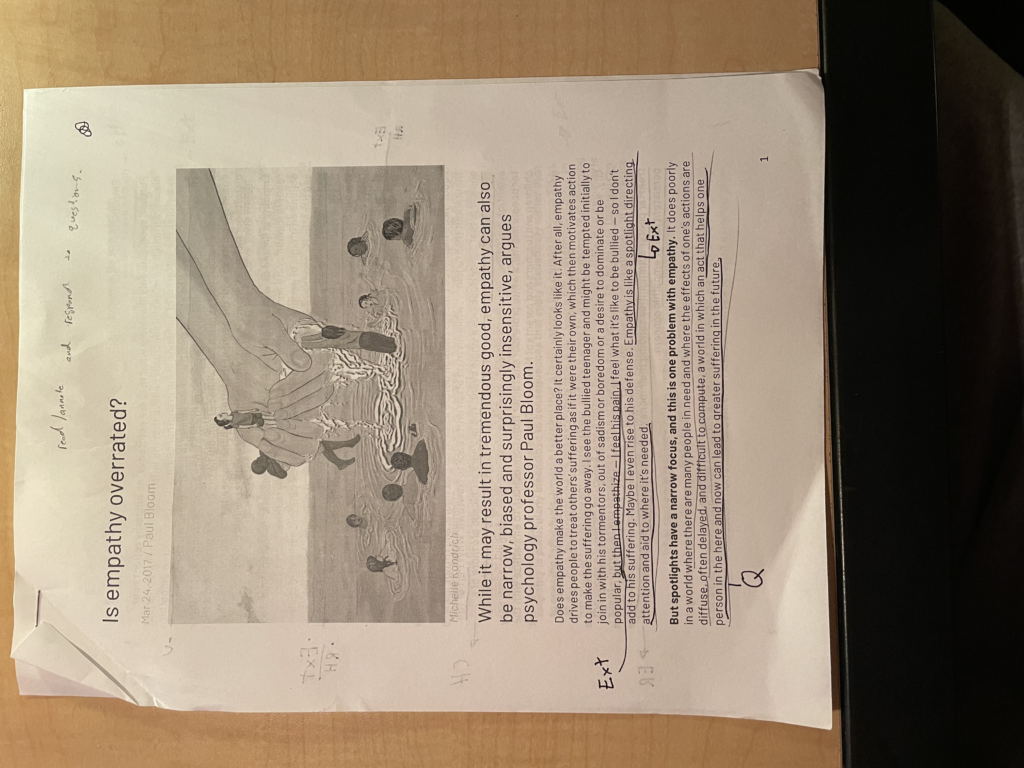
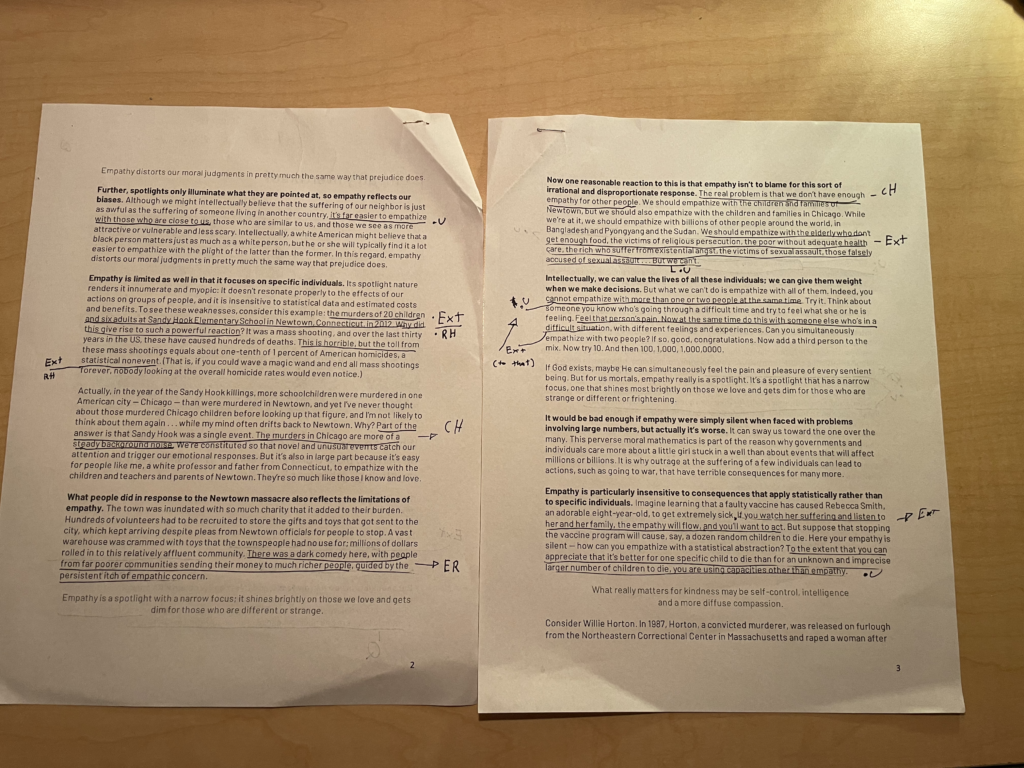
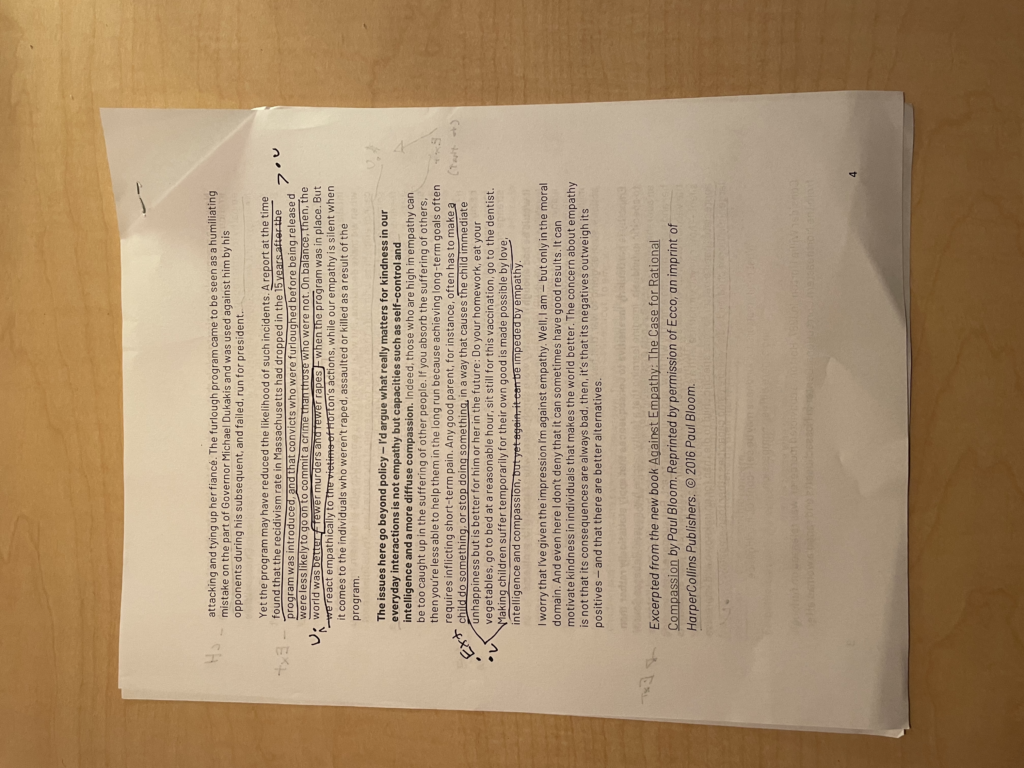
Paul Bloom’s essay challenges the common belief that empathy is always a positive in decision-making. He argues that empathy, defined as feeling what others feel, can be biased, narrow, and even harmful. Instead, Bloom suggests that rational compassion and moral reasoning should guide our actions rather than emotional empathy alone. Throughout the piece, he emphasizes that empathy can mislead us, causing favoritism and poor judgments. Bloom’s three main points include: Empathy is biased and selective, as he says that “Empathy is a spotlight that shines on some people and leaves others in darkness,” and that empathy can lead to poor decisions like “Empathy often causes us to focus on individuals rather than groups, which can distort our sense of justice.” Another point he brings up is the use of logic and values instead of just feelings when deciding what’s right. He expresses this when saying, “We should rely on reason and principles rather than empathy to make ethical choices.”
Bloom challenges my initial thoughts on empathy by showing that it’s not always the best guide for making moral choices. I used to think empathy was just good overall, but he points out that it can sometimes be overwhelming or just unfair. His idea of smart kindness, balancing kindness with reason, helps me see that being kind isn’t just about feelings but about using thought to make better decisions. This shifts my view from seeing empathy as the only way to connect with others to understanding that thoughtful kindness is often more important.
A strong claim from Bloom that sparked a strong response, “Empathy is a spotlight that shines on some people and leaves others in darkness.” This highlights how empathy can be unfair and partial. From my perspective, empathy can indeed be selective, it also serves as a tool for kindness. I think learning how to expand our empathy beyond just those Infront of us would be key.
A discussion question is “How can we express smart kindness when people mostly care about feelings and doing what’s right and not just what we feel?”

Leave a Reply